Touring the North Coast 500 by Campervan: Route, Restrictions and Lessons Learned
The North Coast 500 is the drive most UK touring owners put at the top of the list, and the one that teaches you the most about your own outfit. We did it in a 6.4-metre campervan across nine days, and came home with a notebook full of things we would do differently. Here is the honest version of the NC500 campervan route: how the road actually behaves, where you can stop, and what we would change next time.
What the NC500 campervan route actually asks of you
The route is roughly 516 miles around the top of Scotland, starting and finishing at Inverness. On paper that sounds gentle. In practice, the numbers that matter are not mileage but width and height.
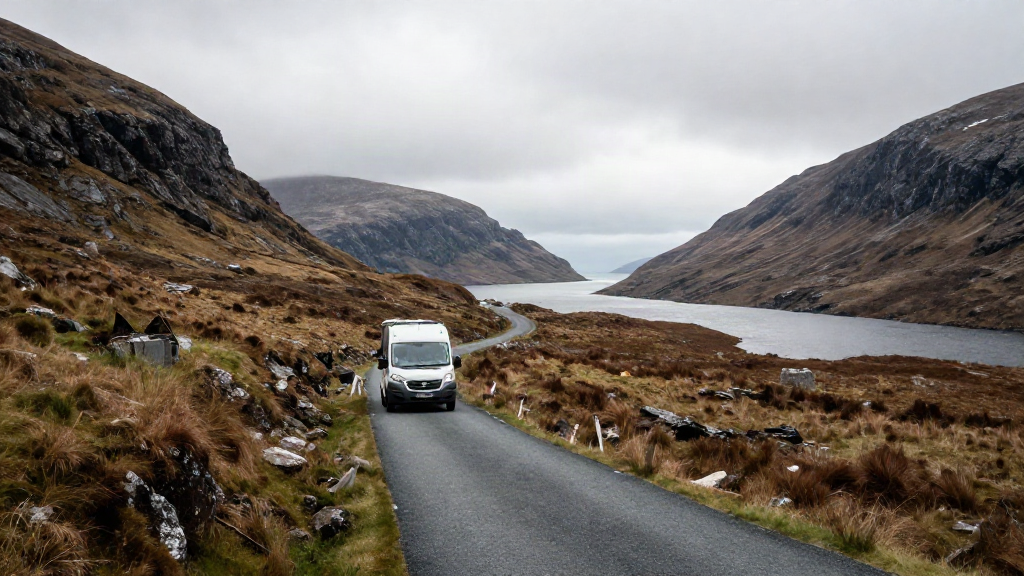
Most of the western leg - Applecross, Torridon, Assynt - is single-track road. That means one lane, a continuous ribbon of tarmac, and passing places set at intervals. You will reverse. You will do it on a blind bend with a motorhome behind you. The first time is stressful; by day three it is routine, provided you know your own dimensions and can judge them.
That is the real lesson: the road is manageable, but only if you have planned around your vehicle rather than for a car.
Single-track sections and passing places
A few rules that made the difference for us:
- Know your width to the centimetre. Ours is 2.3m with mirrors folded. On a single-track road that figure decides whether you squeeze past or pull in.
- Treat every passing place as yours to use. If you see one and a vehicle is approaching, pull in early rather than hoping to meet somewhere wider.
- If you are the larger vehicle, you have the longer reverse. It is unspoken etiquette, and it keeps things calm.
- Pull over for locals. They drive these roads daily and they will thank you with a wave.
Oncoming traffic is not the only hazard. Low branches, tight bridge parapets and unmarked height restrictions on some side roads catch drivers who are thinking in car-sized terms. This is exactly the sort of thing a sat nav built for motorhomes and caravans handles for you: enter your vehicle's height, width and weight once, and the routing avoids the approaches you cannot take.
Height, width and weight: planning before you go
Before we left, we wrote our numbers on a card and stuck it to the dash. Height 2.9m, width 2.3m, weight 3,500kg. It sounds fussy. It stopped us from turning down a coastal lane with a 2.5m height bar and having to reverse a long way back.
Check three things before you commit to a section:
- Bridges and tunnels. Most are signed, but not all, and the signage appears late.
- Site access roads. A campsite can look perfect online and then offer a 1-in-5 gravel climb to the pitch. Ring ahead if you are unsure.
- Fuel range. The north-west has long gaps between filling stations. Plan your stops rather than assuming one will appear.
Overnight stops: campsites that actually take your outfit
This is where most first-timers lose a day. The NC500 is popular, and in peak season the well-known sites fill up months ahead. We booked the first three nights and then improvised - which worked in September and would not have worked in July.
What we learned about choosing a stop:
- Filter by pitch size, not just location. Plenty of sites accept motorhomes but only up to a certain length and only on hardstanding.
- Check the approach, not just the postcode. A site two miles off the route on a single-track lane is not the same as one on the main road.
- Use the route itself as a filter. Planning your overnight stops as part of the day's drive, rather than as a separate search, saves an hour of circling.
A purpose-built app makes this simpler because the map and the campsites live in the same place. You can see 6,000+ UK campsites alongside your route and pick stops that suit your vehicle, rather than cross-referencing three tabs and a notebook.
Where we stopped and why it worked
Our best nights were the least planned: a small site near Gairloch with hardstanding and a sea view, and a croft site on the north coast where the owner met us at the gate. The worst was a stop we chose for its location alone - a beautiful spot reached by a lane our campervan had no business being on.
What we would change next time
Three changes, all small:
- Shorter driving windows. We planned 100-mile days and drove 140. On single-track roads, distance means nothing; time behind the wheel does. Forty miles an hour is a good day, not a slow one.
- Backup stops, not backup plans. We now note two alternatives for every night. One call ahead saves a late arrival in the dark.
- A mid-trip reset. We built in no rest day and finished tired. A full day parked up somewhere on the west coast would have made the second half better.
The takeaway
The NC500 campervan route is not difficult, but it is different from any other UK drive. It rewards preparation: knowing your dimensions, respecting the passing places, and choosing stops that suit your vehicle rather than the photograph. Get those three right and the road gives you back the thing you came for - the sense of touring somewhere genuinely wild, with the confidence that your outfit fits.
If you want that confidence built into your navigation, enter your vehicle's dimensions once and let the route do the thinking. Try it free for 7 days and see how different the north coast feels when the planning is already done.